
Spatial Economics
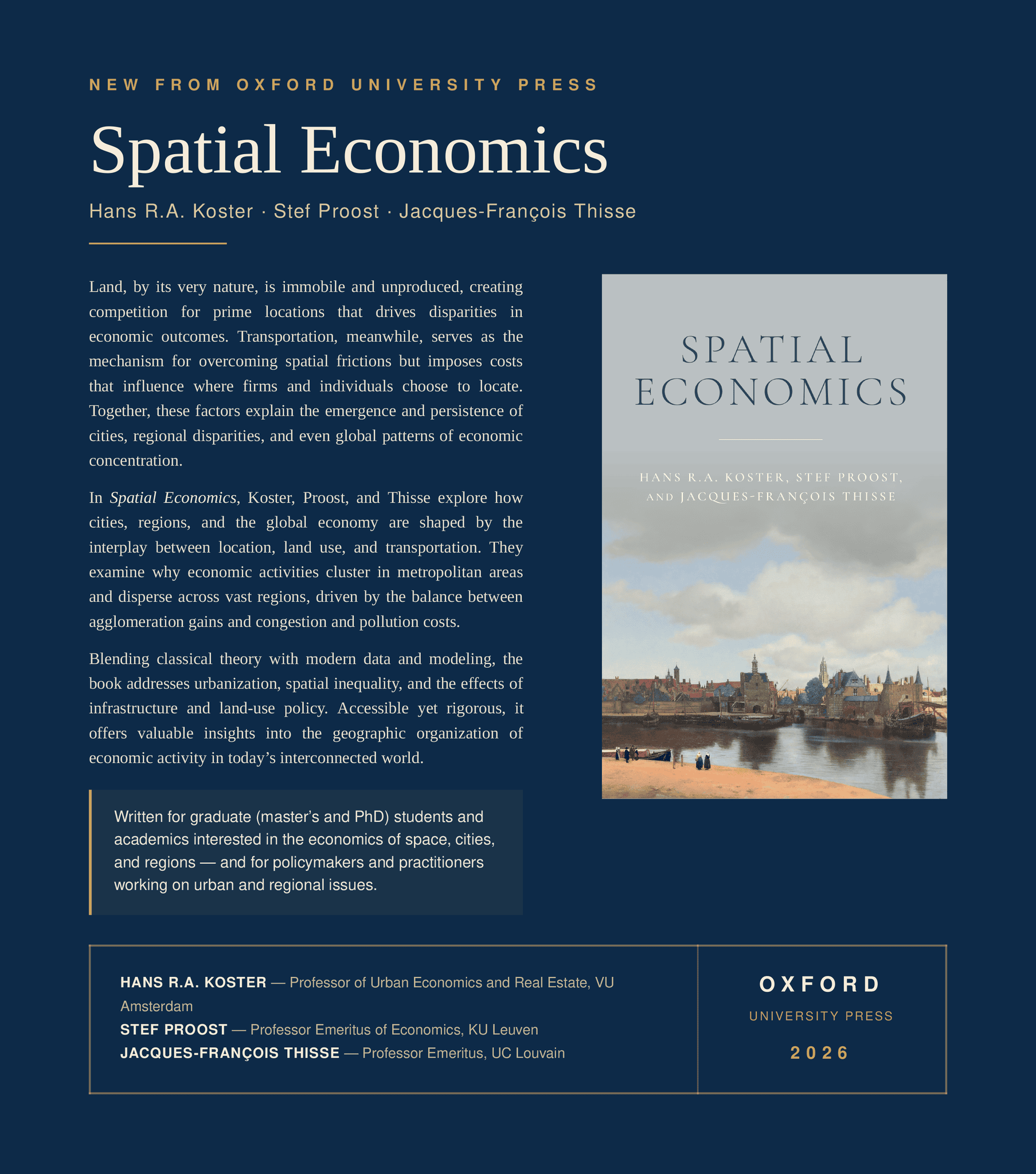
Our new book, Spatial Economics (Hans R.A. Koster, Stef Proost and Jacques-François Thisse, Oxford University Press, 2026), is now in print. The US edition appeared earlier this year; the European edition took a few more months to arrive.
Spatial economics deals with understanding the spatial organization of the economy and how it is shaped by the interaction between the locational choices made by different types of agents and the mobility of goods and factors. Firms and people are distributed very unevenly across localities, cities and regions: more than half of the world’s population lives in urban areas that occupy less than 3% of the inhabitable land. The aim of spatial economics is to explain (i) why people and economic activities are agglomerated in a few places and regions; (ii) why some places and regions fare better than others; and (iii) whether there is a causal relationship between the two.
To study these questions we take as our starting point the two quintessential spatial goods: land and transportation. The geographical organization of the economy at different scales can be viewed as the outcome of the interplay between “centripetal forces” that push toward the agglomeration of activities and “centrifugal forces” that push toward their dispersion. The book combines classical location theory and modern urban economics, as well as theoretical and empirical models, and covers urban, regional and transportation economics in a single volume.
Each chapter closes with empirical illustrations drawn from a wide range of contexts: greenbelt policies, railways and agricultural land values, local employment elasticities, driving restrictions in Mexico City, place-based policies in the United States, land use regulation in India and the UK, among many others.
Ancillary teaching materials, including slides and screencasts, can be found on the companion website: www.oup.com/us/spatialeconomics.